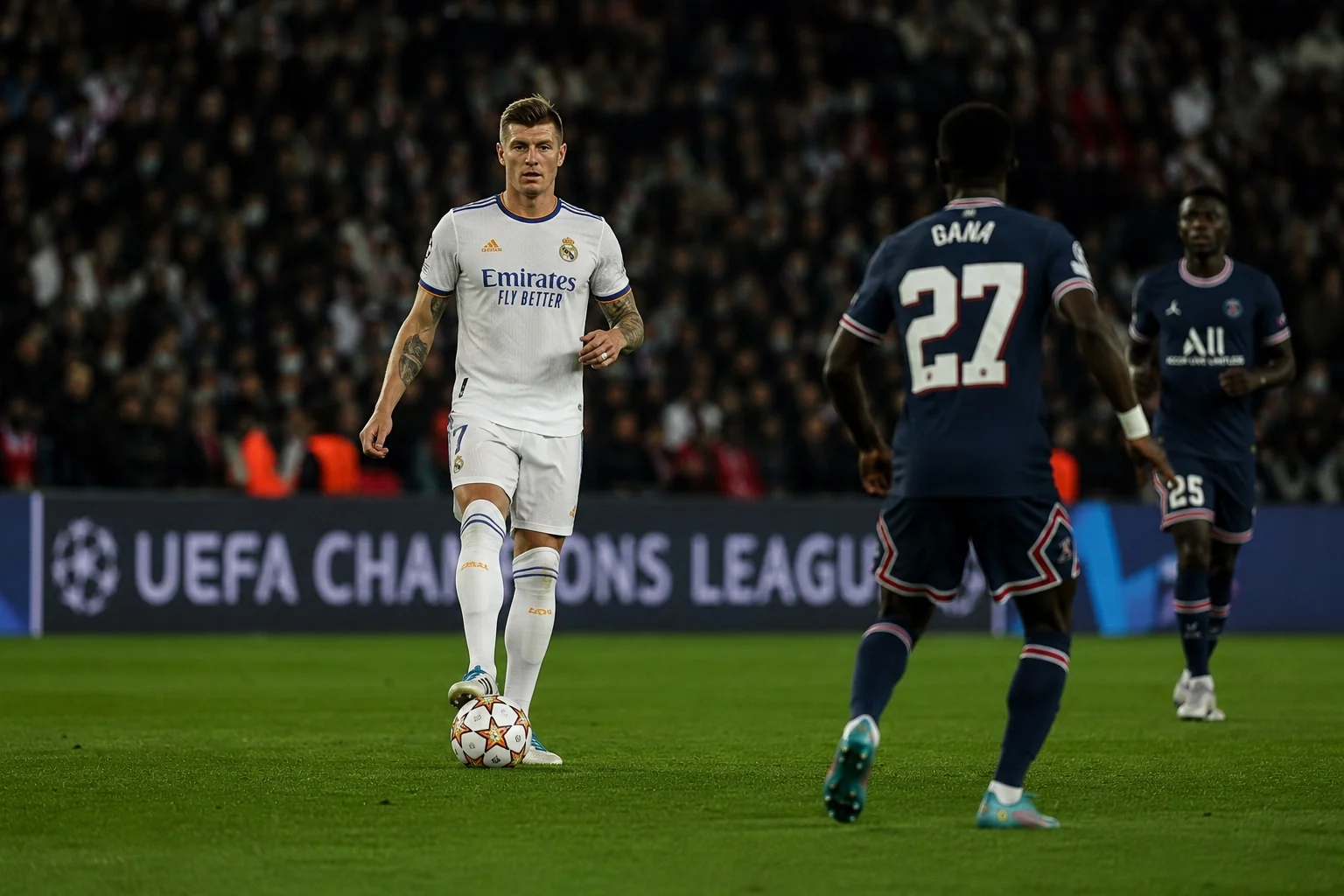
Few football positions demand as much energy and versatility as the box-to-box midfielder. These players are responsible for contributing in both penalty areas, helping their team defend, build attacks, create chances, and score goals.
What Is a Box to Box Midfielder? Role, Position & Famous Examples
Unlike specialist midfield roles such as the regista or trequartista, a box-to-box midfielder must excel in almost every phase of the game. Their ability to cover large distances and influence both ends of the pitch makes them one of football’s most valuable assets.

What Is a Box to Box Midfielder?
A box-to-box midfielder is a central midfielder who regularly contributes in both the defensive and attacking penalty boxes. The term comes from their unyielding tendency to travel from one penalty box to the other throughout a match. Rather than focusing solely on deep defending or advanced chance creation, box-to-box midfielders directly influence every single phase of play on the pitch.
What Does a Box to Box Midfielder Do?
The all-action role combines high defensive responsibility, seamless ball progression, and aggressive attacking support. During an active 90-minute match, they execute several structural tasks:
- Wins the Ball: Box to box midfielders frequently help recover possession deep in their own half through pressing, tackling, and clean interceptions.
- Progresses Play: After winning possession back, they drive forward using powerful ball-carrying sequences or help move attacks through the middle third.
- Supports Attacks: They make relentless forward runs to support frontlines and establish numerical overloads in dangerous half-spaces.
- Scores Direct Goals: Many profiles provide a heavy goalscoring threat by arriving late as an unmarked option inside the penalty box.
- Provides Defensive Cover: The moment team possession is overturned, they sprint back to protect their center-backs.
“
“To play box to box, you must have the engine to defend your own box and the desire to attack the opponent’s.”
Box to Box Midfielder Position Explained
A box-to-box midfielder typically operates as a central midfielder (traditionally wearing the number 8 shirt). Unlike isolated holding midfielders who anchor deep, or specialized number 10 playmakers who stick high up the field, box to box profiles fluidly migrate across both boxes. They serve as the functional engines in these common formations:
- 4-3-3: Operating as one of the twin interior advanced midfielders alongside a holding number 6.
- 4-2-3-1: Aligning in the double-pivot base to balance deep defensive duties with vertical transitions.
- 4-4-2: Functioning in a central midfield duo, requiring massive coverage to avoid being outnumbered.
- 3-5-2 / 5-3-2: Operating as an interior runner with the freedom to burst into spaces cleared by wing-backs.
Key Traits of a Box to Box Midfielder
Mastering this demanding position requires a comprehensive physical and technical profile:
- Elite Stamina: Covering up to 12-13 kilometers per match demands superior aerobic and anaerobic fitness.
- High Work Rate: A non-stop psychological desire to consistently stay involved across all match transitions.
- Tactical Awareness: Perfect calculation to know exactly when to advance to attack or hold position to cover a counter-threat.
- Passing Versatility: Delivering short combination escapes or progressive long balls with identical precision.
- Ball Carrying Power: The ability to physically drive through midfield challenges during transitional phases.
- Defensive Integrity: Possessing excellent tackling timing, physical duel dominance, and tracking awareness.
Box to Box Midfielder vs. Defensive Midfielder
While they often share real estate in the middle third of the pitch, their core roles within a team’s framework are explicitly separate.
Box to Box Midfielder vs. Mezzala
In modern tactical frameworks, it is equally vital to separate general all-action vertical midfielders from specialized pocket runners.
Famous Box to Box Midfielders
Steven Gerrard
Gerrard masterfully combined elite, vocal leadership, long-range scoring power, exceptional passing distribution, and intense tackling desire throughout his historic career with Liverpool, setting the ultimate standard for the role.
Frank Lampard
As one of the highest-scoring midfield players in football history, the Chelsea icon completely perfected the art of tracking match build-ups and making late, calculated runs into the box to finish off high-value chances.
Patrick Vieira
Vieira completely dominated midfields through pure physical stature, elite ball-winning capabilities, and long, powerful progressive strides that drove Arsenal’s historic modern campaigns forward.
Yaya Touré
Touré blended unstoppable physical strength, delicate technical skill, and final-third attacking output, famously scoring over 20 Premier League goals in a single season as Manchester City’s complete midfield hub.
Jude Bellingham
Bellingham represents the absolute pinnacle of the modern, data-driven evolution of the role—contributing at elite statistical levels across defensive recoveries, possession manipulation, and final-third box entries.
Advantages and Disadvantages of the Box to Box Midfielder
The Advantages
- Impacts Every Single Phase: Directly assists teams across deep defense, mid-block transitions, and advanced attack.
- Injects Midfield Mobility: Significantly elevates collective team intensity, pressing capability, and physical coverage.
- Adds Direct Goal Threat: Late central runs into the penalty box generate high-percentage scoring options.
- Supports High-Pressing Systems: Exceptional athletic conditioning is perfectly suited to modern gegenpressing blocks.
- Improves Structural Balance: Connects defensive lines smoothly with attacking blocks during fast transitions.
The Disadvantages
- Massive Physical Barriers: Demands completely elite levels of fitness, risking quick mid-season exhaustion.
- Can Fracture Defensive Lines: Aggressive forward runs can leave gaping central pockets open behind if not carefully matched by a holding midfielder.
- Requires High Discipline: Poor tactical calculation or over-committing can break down the manager’s defensive layout.
- Extreme Difficulty to Master: Incredibly few global profiles possess the robust mix of defensive and offensive skills needed.
Why Are Box to Box Midfielders Important?
Modern elite football increasingly values multi-functional, versatile assets who can seamlessly adapt across tactical phases. The box-to-box midfielder provides exactly that blueprint. By flawlessly blending hard defensive work, transitional progressive carries, and final-third overlapping support, they allow contemporary teams to maintain absolute structural balance while executing high-intensity pressing rhythms across the entire match.
Frequently Asked Questions
What is a box to box midfielder in football?
A box-to-box midfielder is an all-action central midfielder tasked with contributing heavily to both defensive duties and attacking sequences across both ends of the pitch.
Why is the position specifically called a box to box midfielder?
The name stems directly from the player’s relentless vertical movement, tracking from their own defensive penalty box to the opponent’s attacking box throughout the match.
Who stands as the greatest box to box midfielder of all time?
Elite legends like Steven Gerrard, Frank Lampard, Patrick Vieira, and Yaya Touré are universally analyzed as the absolute finest historical examples to ever perform the role.
Is Real Madrid’s Jude Bellingham classified as a box to box midfielder?
Yes. Bellingham is widely recognized by contemporary analysts as the absolute finest modern embodiment of a traditional box-to-box midfielder active today.