
AC Milan Red · Oranje Orange · Illustrated Football Story
Ballon d’Or winner. EURO-winning captain. European champion. Ruud Gullit turned versatility into authority and made elite football look broader than the positions written on a team sheet.
Ruud Gullit: Career, Playing Style, AC Milan & EURO 1988 Legacy
Ruud Gullit was one of football’s most complete elite players: a powerful Dutch attacker and midfielder who won the 1987 Ballon d’Or, captained the Netherlands to EURO 1988 and became a central figure in AC Milan’s great late-1980s and early-1990s teams. His defining quality was range. He could create, carry, press, head, finish, lead and change roles without losing influence.
The fastest way to understand Gullit is to stop looking for one permanent position. UEFA describes him as a versatile attacking player, and his career backs that up. He could operate as a forward, attacking midfielder, wide attacker or deeper midfield presence depending on the phase and the team around him.
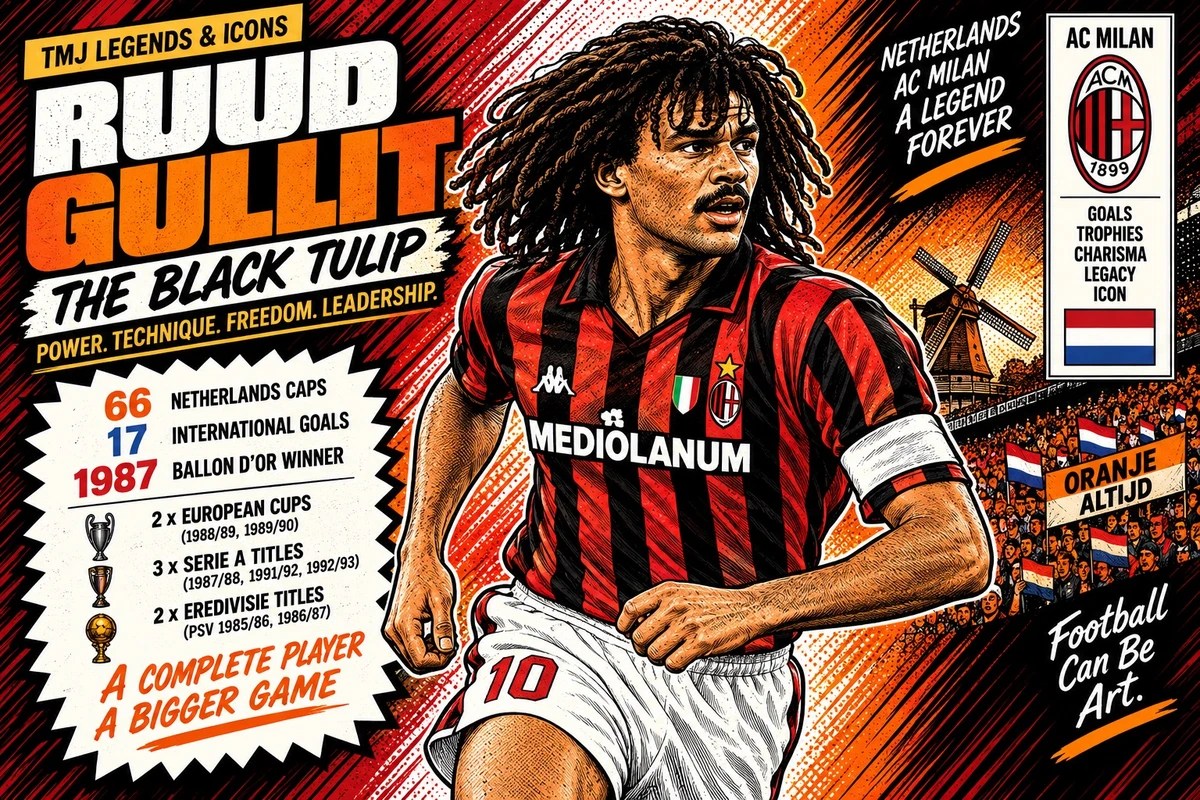
That flexibility did not dilute his output. He scored heavily at PSV, became the Ballon d’Or winner in 1987, helped Milan win Serie A and two European Cups, and finished his Netherlands career with 66 caps and 17 goals.
Ruud Gullit At A Glance
Amsterdam To Haarlem: The First Version Of Gullit
Ruud Gullit was born on 1 September 1962 in Amsterdam. He entered senior football with HFC Haarlem in 1979 and quickly stood out because he did not fit the usual physical or positional profile of a young Dutch prospect.
He was tall, athletic and powerful, but his game was built around technique as much as physique. That mixture became the foundation of everything that followed: Gullit could absorb contact without becoming static, travel with the ball without losing balance and attack aerially without becoming a one-dimensional target player.
The nickname “Black Tulip” captured the contrast neatly: Dutch elegance with a more explosive visual and physical edge.
Feyenoord And PSV: From Dutch Champion To World-Record Transfer
Feyenoord gave Gullit his first major domestic peak. In 1983/84, he played in the side that won the Eredivisie and KNVB Cup double, sharing a dressing room with Johan Cruyff. Feyenoord’s own history records that 1984 double as a major revival for the club.
PSV then accelerated the numbers. The club records Gullit scoring 24 goals in 1985/86 and 22 in 1986/87 as PSV won back-to-back league titles. A separate PSV history feature lists 75 appearances and 53 goals across his two seasons there.
By 1987, he was ready for Serie A. PSV records his transfer to AC Milan at 16.5 million guilders, then a record fee. The move placed Gullit inside the most demanding league of the era and inside a club about to redefine European football.
AC Milan: Sacchi, The Dutch Trio And European Power
Gullit joined AC Milan in 1987 alongside Marco van Basten, with Frank Rijkaard arriving the following year. Together they became Milan’s celebrated Dutch trio, surrounded by a core that included Franco Baresi, Paolo Maldini, Carlo Ancelotti and Roberto Donadoni.
Arrigo Sacchi’s system demanded collective pressing, compact distances and synchronized movement. Gullit fit because he could contribute to more than one phase. He could lead the press, attack channels, carry through midfield, combine around the box and finish moves.
AC Milan’s official history records the 1987/88 Scudetto as the club’s first league title in eight years and identifies Ballon d’Or winner Gullit as one of the driving forces. Milan then won back-to-back European Cups in 1989 and 1990. UEFA notes that Gullit scored twice in the 1989 final against Steaua București and returned from a long injury spell to play in the 1990 final against Benfica.
EURO 1988: Captain, Opening Goal, First Major Dutch Title
EURO 1988 gave Gullit’s international career its defining image. UEFA records him as the captain of the Netherlands side that beat the Soviet Union 2-0 in the final in Munich and became the first Dutch men’s team to win a major international tournament.
Gullit scored the opening goal with a powerful header after Marco van Basten redirected the ball across the box. Van Basten’s famous volley later made it 2-0, but Gullit’s goal changed the match first. The captain did not simply lift the trophy; he put his name on the final.
How Ruud Gullit Played: The Position-Rich Superstar
Gullit was not “positionless” because he lacked definition. He was position-rich because he could perform multiple elite jobs. UEFA lists him as a forward in some historical material and describes him more broadly as a versatile attacking midfielder or attacker. PSV remembers him functioning on the right or through the center at Milan.
Carry Through Contact
His strength allowed him to protect the ball, but his stride meant he could keep moving instead of merely shielding.
Create And Combine
He could receive between lines, combine quickly and keep attacks moving without becoming a static playmaker.
Attack The Finish
His aerial power and timing made him dangerous inside the box, while his technique kept him useful outside it.
The modern game has specialists for pressing, carrying, aerial duels and chance creation. Gullit’s fascination is that he could overlap several of those categories at once. He could resemble a trequartista in one phase and a center-forward in the next.
Netherlands: 66 Caps, 17 Goals And A Crown In Orange
UEFA records Gullit ending his Netherlands career in 1994 with 66 caps and 17 goals. He appeared at the 1990 World Cup and returned to a major-tournament semi-final at EURO 1992, where the Netherlands lost to eventual champions Denmark on penalties.
The defining chapter remains 1988 because the Netherlands had long been associated with beautiful football without a senior men’s major trophy. Gullit became the first Dutch captain to lift one.
That combination of captaincy and technical freedom is central to his legacy. Gullit was not a decorative leader. He was tactically central to the team he led.
Sampdoria And Chelsea: Reinvention At The End
After Milan, Gullit moved to Sampdoria and remained influential enough to help the club win the 1993/94 Coppa Italia. UEFA’s career summary includes the 1994 Italian Cup among his major honours.
Chelsea offered one final reinvention. Gullit arrived in England in 1995 and became player-manager in 1996. Chelsea’s official history credits him with helping modernize the club’s playing and recruitment culture while giving the team a more continental identity.
In 1997, Chelsea beat Middlesbrough 2-0 in the FA Cup final. The club notes that Gullit became the first foreign manager and first Black manager to win a major trophy in England. It was a managerial milestone attached to a playing career already full of them.
The 1987 Ballon d’Or And Nelson Mandela
France Football’s official winners list records Gullit as the 1987 Ballon d’Or winner. Gullit later wrote for Laureus that he dedicated the award to Nelson Mandela, who was still imprisoned under apartheid.
In that Laureus reflection, Gullit explained that anti-apartheid activism was already part of the cultural environment around him in the Netherlands. The dedication therefore was not an afterthought attached to fame; it came from a cause he had been following before the award night.
That moment matters because it adds context to his public identity without turning a football profile into a political biography. The point is simpler: Gullit used football’s biggest individual stage to make a human-rights statement that remained part of his own account of the award decades later.
Ruud Gullit Records And Major Honours
Gullit’s honours are spread across the Netherlands, Italy, international football and England. That spread is useful because it shows that his versatility was not confined to one team or one tactical environment.
| Record / Honour | Detail |
|---|---|
| Netherlands | 66 caps · 17 goals |
| UEFA EURO | Champion 1988 · captain · scored opening goal in final |
| Ballon d’Or | Winner 1987 |
| European Cup | Winner 1989, 1990 with AC Milan |
| Serie A | Champion 1987/88, 1991/92, 1992/93 |
| Eredivisie | Champion 1983/84 with Feyenoord; 1985/86 and 1986/87 with PSV |
| KNVB Cup | Winner 1983/84 with Feyenoord |
| Coppa Italia | Winner 1993/94 with Sampdoria |
| FA Cup | Winner 1996/97 as Chelsea player-manager |
Why Ruud Gullit Still Matters
Gullit’s legacy is not simply that he could play many positions. Plenty of players are versatile because they can survive in different roles. Gullit was unusual because he could remain dangerous in different roles.
He belonged comfortably inside Sacchi’s demanding collective system, but he also had enough personality and technical force to look individual within it. He could captain a national team, lead a press, win aerially, carry the ball and still produce decisive moments near goal.
That is why the word “complete” keeps returning to Gullit. The evidence is not aesthetic alone. It runs through the medals: European champion with club and country, Ballon d’Or winner, league champion in two countries and FA Cup-winning player-manager in a third.
Ruud Gullit Questions
Who is Ruud Gullit?
Ruud Gullit is a former Netherlands international, 1987 Ballon d’Or winner, EURO 1988-winning captain and AC Milan icon.
How many caps did Ruud Gullit win for the Netherlands?
UEFA records 66 senior international appearances and 17 goals.
Did Ruud Gullit win the Ballon d’Or?
Yes. France Football lists Gullit as the 1987 Ballon d’Or winner.
What position did Ruud Gullit play?
He played across midfield and attack, including attacking midfield, forward and center-forward roles.
What did Gullit win with AC Milan?
His Milan honours included three Serie A titles and two European Cups, with the European triumphs coming in 1989 and 1990.
What did Gullit achieve at Chelsea?
He became player-manager and led Chelsea to the 1997 FA Cup, the club’s first major trophy in 26 years.
Sources & Verification
Core claims were checked against official club, competition and award sources. Where a statistic comes from a secondary historical database, the article does not elevate it above stronger primary records.
- UEFA: Ruud Gullit profile — 66 caps, 17 goals, 1987 Ballon d’Or, Milan and Netherlands honours
- UEFA: EURO 1988 — Netherlands champions and Gullit’s opening goal in the final
- AC Milan: 1987/88 title season and Gullit’s role
- AC Milan: 1988/89 European Cup-winning season
- PSV: Gullit’s 1985/86 and 1986/87 title seasons and goal output
- Feyenoord: 1983/84 Eredivisie and KNVB Cup double
- France Football: 1987 Ballon d’Or winner
- Chelsea: Gullit and the 1997 FA Cup
- Laureus: Gullit on dedicating his 1987 Ballon d’Or to Nelson Mandela