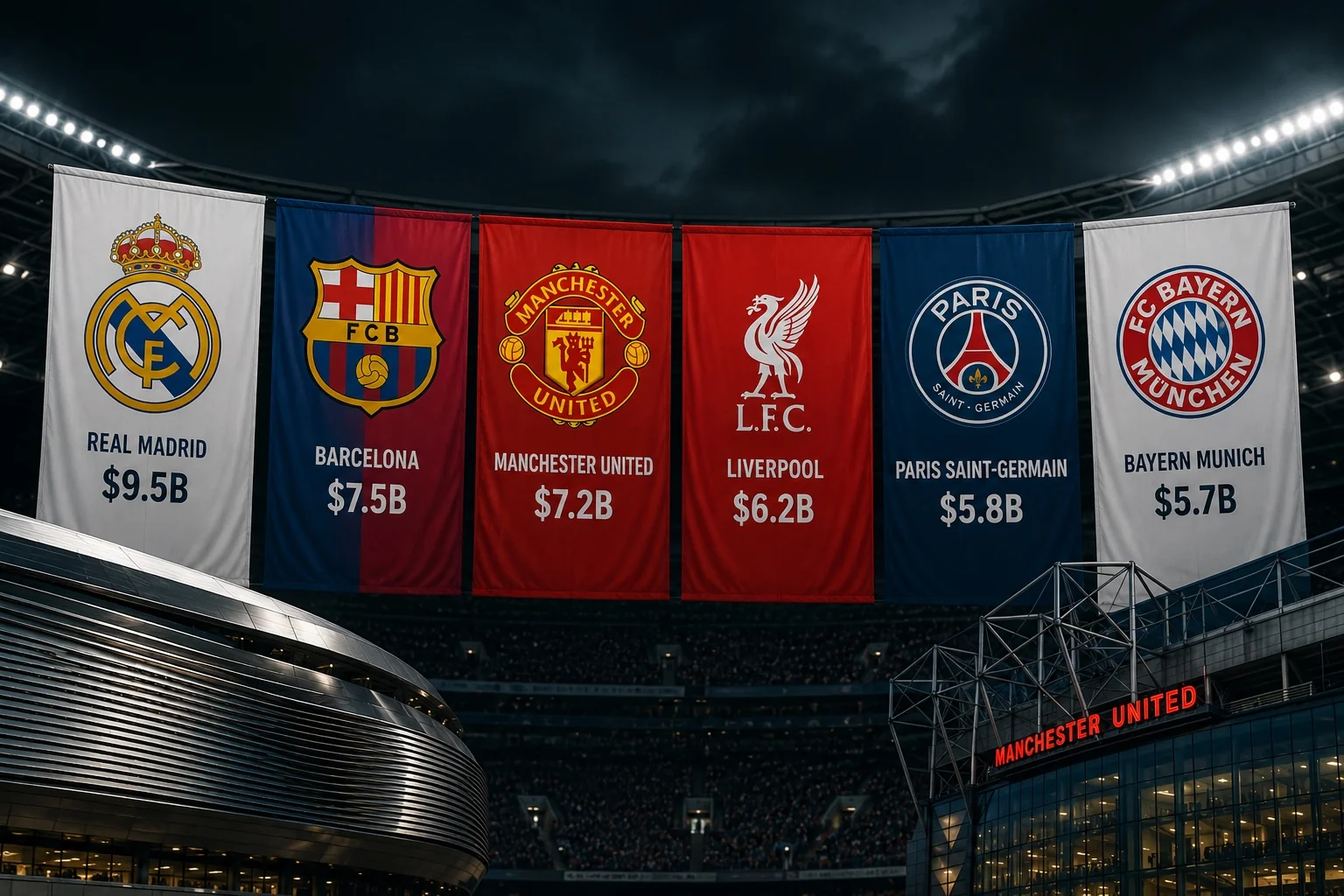
The most valuable football clubs in 2026 are led by Real Madrid, Barcelona and Manchester United, according to Forbes’ latest ranking of the world’s most valuable soccer teams. This ranking matters because club value now reflects more than trophies: stadium power, global revenue, commercial reach, league economics, ownership structure and brand gravity all shape the modern football empire.
Most Valuable Football Clubs 2026: Forbes Top 30 Ranking
This TMJ ranking refines Forbes’ 2026 soccer valuation list into football-first language, with a clean top 30 table, league breakdown, key takeaways and context for why Real Madrid, the Premier League and MLS are shaping the money map of the sport.

Most Valuable Football Clubs 2026: Quick Facts
- No. 1 club: Real Madrid, valued by Forbes at $9.5 billion.
- Top three: Real Madrid, Barcelona and Manchester United.
- Most represented league: English Premier League, with 11 clubs in the top 30.
- Fastest top-10 jump: Arsenal, up 59% year-on-year in Forbes’ valuation.
- MLS presence: seven clubs appear in the top 30, led by Inter Miami.
- Average top-30 value: $2.9 billion, according to Forbes.
- Last updated: 30 June 2026.
Forbes uses the phrase “soccer teams,” but TMJ uses football clubs because that is the cleaner football-language fit for a global audience. The list below is based on Forbes’ 2026 soccer team valuations, with values shown in U.S. dollars.
The ranking is not a list of the best teams on the pitch. It is a business valuation list. That means clubs are measured through enterprise value, revenue, commercial strength, stadium economics, ownership context and market conditions. A club can struggle on the field and still rise financially if its brand, stadium and revenue engine keep growing.
That is why this table belongs beside TMJ’s broader football records archive. It captures another kind of dominance: not goals, trophies or streaks, but the financial muscle behind the modern game.
Most Valuable Football Clubs 2026: Full Top 30 Ranking
Real Madrid sit clear at the top with a $9.5 billion valuation, followed by Barcelona at $7.5 billion and Manchester United at $7.2 billion. The gap between the top two Spanish giants and the rest of world football is still enormous, but the Premier League’s depth is the real story across the full top 30.
Top 10 Breakdown: Why These Clubs Lead The Market
The top 10 is a snapshot of football’s biggest economic machines. Real Madrid and Barcelona show the commercial ceiling of Spanish football. Manchester United, Liverpool, Manchester City, Arsenal, Chelsea and Tottenham show the Premier League’s market depth. PSG and Bayern Munich prove that one-club national dominance can still translate into global financial power.
- Real Madrid: the benchmark club, helped by record revenue, global brand strength and the modernized Santiago Bernabeu.
- Barcelona: still a commercial giant, even after years of financial turbulence and stadium transition.
- Manchester United: proof that global brand power can remain enormous even during difficult sporting cycles.
- Liverpool: one of the clearest examples of sporting identity, global support and commercial growth working together.
- PSG: the only Ligue 1 club in the top 30, but still inside the top five.
- Premier League top six: the English elite remains the densest financial bloc in world football.
The most revealing name may be Arsenal. Forbes lists the club at $5.4 billion, up 59% year-on-year. That rise reflects a broader story around competitive momentum, stadium economics, global fan growth and the premium investors place on elite Premier League clubs.
“
“Modern football wealth is no longer just built on winning. It is built on turning every matchday, every screen and every fanbase into a year-round economy.”
League Breakdown: Premier League Depth, Spanish Peaks And MLS Growth
The Premier League has the most clubs in the top 30, but La Liga owns the first two places. That contrast is the financial riddle of modern football: Spain has the sharpest peaks, England has the deepest mountain range.
The MLS presence is the eyebrow-raiser. Inter Miami, LAFC, LA Galaxy, New York City FC, Atlanta United, Seattle Sounders and Austin FC all appear in the top 30. That does not mean MLS has caught Europe competitively, but it does show the investment value of a closed league, major-market stadium projects, lower relegation risk and American sports-business logic.
For English clubs, the league’s broadcast and commercial ecosystem remains a giant tide. That is why even clubs outside the Champions League conversation can still sit near or above famous continental names. It is also why TMJ’s Premier League transfer window tracker belongs in the same conversation: transfer power often follows revenue power.
Key Takeaways From The Forbes 2026 Club Values
- Real Madrid are in a different lane: the $9.5 billion valuation gives them a $2 billion lead over Barcelona.
- Barcelona’s recovery is visible: the club ranks second despite years of financial scrutiny and stadium disruption.
- Manchester United remain a commercial monster: third place shows the club’s brand strength even after a difficult season.
- The Premier League dominates depth: 11 clubs make the list, more than any other league.
- MLS is no longer a footnote: seven clubs in the top 30 confirm strong investor appetite in the U.S. market.
- Italian clubs are rising but still behind: Juventus, AC Milan, Inter Milan and Roma appear, but none reaches the top 10.
- Stadiums matter more than ever: modern venues are becoming business engines, not just matchday homes.
Deloitte’s Football Money League also shows why revenue matters so much in this debate. Its 2026 report says the top 20 revenue-generating clubs passed €12 billion combined for the first time, with Real Madrid again leading the table at close to €1.2 billion in annual revenue. That context helps explain why valuation lists and revenue lists often rhyme, even when they are not identical.
Club value is not built by one signing, one trophy or one season. It is built by a repeated pattern of global attention. Historic clubs with major trophies, iconic players and deep fan identity also gain long-term brand weight, which is why player legacy pages such as TMJ’s Ballon d’Or winners by club can sit naturally beside business rankings like this one.
Methodology And Scope
This article ranks the top 30 clubs by Forbes’ 2026 valuation list. Forbes describes its valuations as enterprise values, which include equity plus net debt. The figures are based on club economics, revenues, operating income, stadium economics, debts, exchange rates and market comparisons.
For European clubs, Forbes uses the 2024/25 season. For MLS clubs, it uses the 2025 campaign. Values are rounded and shown in U.S. dollars. Because this is a valuation ranking, it should not be read as a sporting power ranking, squad value ranking, trophy ranking or revenue-only ranking.
TMJ uses “football clubs” as the editorial term, while preserving the Forbes source language of “soccer teams” in the source notes. That helps readers find the topic through both global football language and U.S.-leaning search terms such as most valuable soccer teams.
Why Football Club Values Still Matter
Football club valuations matter because they show where influence is moving. The richest clubs can invest in facilities, scouting, wages, data departments, academy networks, women’s teams, global tours and commercial partnerships. Money does not guarantee good decisions, but it expands the menu of choices.
The table also explains why ownership interest keeps rising. Football clubs are no longer viewed only as sporting institutions. They are media brands, real estate plays, global communities, tourism anchors and entertainment platforms. The modern elite club is part stadium, part content studio, part heritage museum and part financial aircraft carrier.
For fans, that can be thrilling and uncomfortable at the same time. The biggest clubs can dream bigger, but the financial gap can stretch competitive balance. That is why valuations are worth tracking alongside trophies, transfers and player value. TMJ’s most valuable footballers 2026 ranking shows the other side of the same economy: the stars who help clubs turn attention into power.
TMJ Verdict: Real Madrid Rule, But England Runs Deep
The 2026 list has two truths. Real Madrid remain the gold standard, with Barcelona close enough to keep the Spanish rivalry at the summit of football finance. But below that peak, the Premier League’s depth is brutal. Eleven clubs in the top 30 is not a coincidence. It is the result of broadcast strength, global consumption and the league’s ability to turn even mid-table brands into billion-dollar assets.
The new wrinkle is MLS. Seven clubs in this ranking show that football value is no longer only an old-European story. The sport’s money map is widening, and the next decade may be shaped by a strange blend of Madrid royalty, Premier League scale, Italian recovery and American investment appetite.
Frequently Asked Questions
What is the most valuable football club in the world in 2026?
Real Madrid are the most valuable football club in the world in 2026, with Forbes valuing the club at $9.5 billion.
Which clubs are in the top three?
The top three most valuable football clubs in 2026 are Real Madrid, Barcelona and Manchester United.
How many Premier League clubs are in the top 30?
There are 11 Premier League clubs in Forbes’ 2026 top 30, more than any other league.
Why are MLS clubs in the top 30?
MLS clubs benefit from closed-league economics, growing stadium assets, American sports investment, market expansion and lower relegation risk compared with European football.
Is this the same as a richest football clubs list?
It is close, but not exactly. This is a valuation ranking, not a cash balance or revenue-only ranking. It estimates overall club enterprise value.
Why does Forbes use soccer teams instead of football clubs?
Forbes is a U.S.-based publication and uses “soccer teams” for its ranking. TMJ uses “football clubs” because it is the clearer global football term.
Fact-Check Notes
This article was fact-checked using Forbes’ 2026 soccer team valuations, a licensed Forbes regional publication mirror, Forbes MLS valuation material and Deloitte’s Football Money League context.