
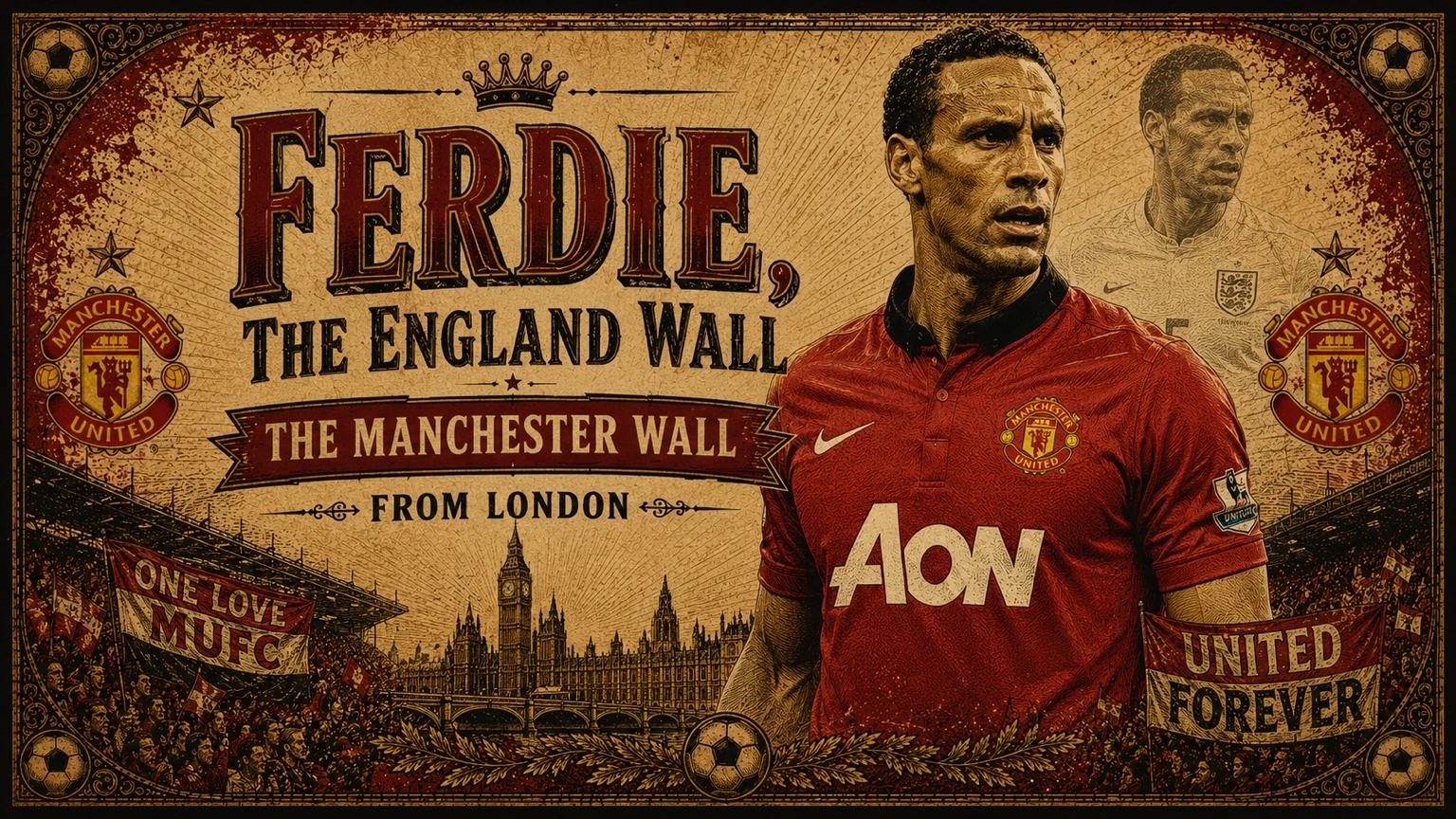
Before Rio Ferdinand became the elegant defensive foundation of Manchester United’s last great dynasty under Sir Alex Ferguson, he was a fearless graduate of West Ham’s Academy of Football who treated possession as an opportunity rather than a danger. His rise reshaped expectations of what an English centre-back could be.
Rio Ferdinand: The Manchester United Defender Who Redefined The English Centre-Back
Rio Ferdinand’s career matters because it connected defensive authority with technical ambition: six Premier League titles, European glory, 81 England caps, record-breaking transfers, and a style that helped move English defending into a more composed and progressive age.

Who Is Rio Ferdinand?
Rio Ferdinand is a former English centre-back best known for winning six Premier League titles and the 2008 UEFA Champions League with Manchester United. Developed at West Ham United, he also played for Bournemouth, Leeds United, and Queens Park Rangers, while earning 81 senior England caps and appearing at three FIFA World Cups.
Rio Ferdinand Career At A Glance
Ferdinand’s record is best understood through two connected careers: a club journey that made him the most expensive defender in the world twice, and an England career built around three World Cups, 81 appearances, and a decade among the national team’s first-choice defenders.


Manchester United gave Ferdinand the stage to define an era. England gave him the responsibility of representing a generation. Together, the two careers made him a blueprint for the modern English centre-back.
Rio Ferdinand Profile
- Full Name: Rio Gavin Ferdinand
- Nickname: Rio
- Date Of Birth: November 7, 1978
- Place Of Birth: Camberwell, London, England
- Country: England
- Position: Centre-Back
- Main Clubs: West Ham United, Leeds United, Manchester United, Queens Park Rangers
- Known For: Ball-playing composure, recovery speed, anticipation, one-against-one defending, leadership, and his partnership with Nemanja Vidić
- Major Honours: Six Premier League titles, 2007–08 UEFA Champions League, two League Cups, and the 2008 FIFA Club World Cup
Peckham, Ballet And The Academy Of Football
Rio Gavin Ferdinand was born on November 7, 1978, in Camberwell and raised in Peckham, south London. His childhood was filled with movement and competition. Football became the central pursuit, but Ferdinand also explored dance and ballet, experiences that contributed to the coordination, balance, and light-footed athleticism later visible in his defending.
He joined West Ham United’s youth system as a teenager and entered an academy renowned for developing technically confident footballers. The environment suited him. West Ham did not ask young defenders merely to clear danger. They were expected to understand possession, receive the ball under pressure, and contribute to the construction of attacks.
Ferdinand initially possessed the freedom and curiosity of a midfielder. West Ham gradually shaped those qualities into the profile of a centre-back. The result was unusual for English football in the mid-1990s: a defender who could recover with pace, survive isolated duels, and carry the ball forward without treating the halfway line as a border.
West Ham And The Birth Of A Modern Defender
Ferdinand made his West Ham first-team debut in 1996 and quickly emerged as one of the most exciting young defenders in England. A short loan spell at Bournemouth supplied additional senior experience, but his long-term stage was already waiting at Upton Park.
His composure distinguished him from many centre-backs of the period. Ferdinand could step beyond the first line of pressure, carry possession into midfield, and select a progressive pass instead of surrendering the ball. Those actions were not decorative. They allowed West Ham to escape pressure and begin attacks with greater control.
He was named West Ham’s Hammer of the Year for the 1997–98 season and became a senior England international while still developing at club level. By the time larger clubs arrived, Ferdinand was no longer simply an academy success. He represented a different future for English defending.
Leeds United And The First Record Transfer
Leeds United signed Ferdinand from West Ham in November 2000 for approximately £18 million. The move made him the most expensive British footballer of the time and one of the world’s costliest defenders. The fee carried pressure, but it also reflected the rarity of his profile.
At Elland Road, Ferdinand joined an ambitious young team featuring players such as Jonathan Woodgate, Alan Smith, Harry Kewell, and Mark Viduka. Leeds reached the Champions League semi-finals during the 2000–01 season, meeting Valencia after a European run that accelerated Ferdinand’s education at the highest club level.
He later became Leeds captain, adding authority and responsibility to his technical qualities. Yet the club’s financial problems made another transfer increasingly likely. After England’s 2002 World Cup campaign, Manchester United moved decisively and broke the British transfer record again to sign him.
Manchester United And A Defensive Dynasty
Manchester United signed Ferdinand in July 2002 for a fee reported at around £30 million. For the second time, he became the most expensive British footballer, and the transfer also established another record for a defender. Sir Alex Ferguson was investing not only in defensive security but in the way United wanted to begin attacks.
Ferdinand won the Premier League during his first season, but his United journey was not without disruption. An eight-month suspension for missing a drugs test removed him from competitive football during 2004. His return required patience and focus, and the following years became the most successful period of his career.
The arrival of Nemanja Vidić in 2006 created one of the Premier League’s defining centre-back partnerships. Vidić brought aggression, aerial dominance, and physical confrontation. Ferdinand supplied speed, positional control, distribution, and protection behind the line. Their differences fitted together like two parts of the same defensive machine.
“
Rio Ferdinand defended with the calm of a player who had already seen the danger, measured it, and removed its oxygen.
The Rio Ferdinand Playing Style
Rio Ferdinand was a ball-playing centre-back before the role became a routine requirement at elite clubs. His defending relied less on constant collision than on anticipation, positioning, recovery speed, and the ability to remain composed while attackers accelerated toward him.
Ball-Playing Composure
Received possession under pressure, stepped into midfield, and passed through lines without abandoning defensive security.
Recovery Speed
Covered space behind attacking full-backs and recovered against forwards who appeared to have escaped the defensive line.
Reading And Control
Tracked developing attacks early, protected dangerous zones, and often intercepted before a desperate tackle became necessary.
His elegance did not mean softness. Ferdinand could compete physically, defend aerial balls, and confront elite forwards. The difference was that he preferred control over chaos. When his positioning and anticipation worked correctly, the difficult tackle disappeared before it was required.
Moscow 2008 And European Glory
The 2007–08 season became the summit of Ferdinand’s Manchester United career. United conceded only 22 goals across the Premier League campaign, retained the league title, and reached the Champions League final after navigating a European path that included Roma and Barcelona.
In Moscow, Ferdinand captained United alongside Ryan Giggs as the match against Chelsea moved through rain, extra time, and penalties. The contest finished 1-1 before United won the shootout 6-5. Ferdinand then lifted the European Cup with Giggs, completing a season in which United’s defensive structure had been as important as its attacking stars.
The triumph confirmed Ferdinand’s place among Europe’s leading defenders. Later that year, United also won the FIFA Club World Cup. The league, Europe, and world titles created a golden sequence and supplied the defining trophies of his career.
Three World Cups And The England Years
Ferdinand made his senior England debut in 1997 and travelled to the 1998 World Cup as the youngest member of Glenn Hoddle’s squad. Although he did not play in France, the selection announced his arrival among the country’s most important defensive prospects.
He became a starter at the 2002 World Cup, scoring against Denmark in the round of 16 as England reached the quarter-finals. Ferdinand returned for the 2006 tournament in Germany and again formed part of a defence that conceded sparingly before Portugal eliminated England on penalties.
England named Ferdinand captain before the 2010 World Cup, but a knee injury suffered in training ruled him out shortly before the tournament began. It was a cruel interruption to what should have been another defining international chapter. He finished his England career in 2011 with 81 appearances and three goals.
Why Rio Ferdinand Still Matters
Rio Ferdinand still matters because he changed the vocabulary surrounding English centre-backs. Before possession-based defending became a universal coaching demand, he demonstrated that a defender could protect his goal while also controlling tempo, advancing the ball, and improving the team’s first phase of attack.
His honours establish the scale of the career. Six Premier League titles, the Champions League, two League Cups, and the FIFA Club World Cup made Ferdinand one of the most decorated English defenders of the Premier League era. His 2023 induction into the Premier League Hall of Fame formally recognised that influence.
The deeper legacy sits in the players who followed. Modern defenders are now judged by their ability to receive, carry, and progress possession as well as stop attacks. Ferdinand did not invent every part of that role, but in English football he became one of its clearest and most influential demonstrations.
TMJ Verdict: The Defender Who Made Calmness Powerful
Rio Ferdinand was more than a decorated Manchester United centre-back. He was a bridge between two defensive eras: one built around clearing danger and another built around controlling it. His speed protected the space behind him, but his mind usually arrived before his legs were required.
West Ham gave him the technical foundation, Leeds accelerated his rise, and Manchester United turned his qualities into a dynasty. Ferdinand did not make defending look easy. He made difficult defending look calm.
Frequently Asked Questions
Who is Rio Ferdinand?
Rio Ferdinand is a former England centre-back who played for West Ham United, Bournemouth, Leeds United, Manchester United, and Queens Park Rangers.
How tall is Rio Ferdinand?
Rio Ferdinand is approximately 1.89 metres, or 6 feet 2 inches, tall.
Which clubs did Rio Ferdinand play for?
Ferdinand played senior football for West Ham United, Bournemouth on loan, Leeds United, Manchester United, and Queens Park Rangers.
How many Premier League titles did Rio Ferdinand win?
Rio Ferdinand won six Premier League titles with Manchester United in 2002–03, 2006–07, 2007–08, 2008–09, 2010–11, and 2012–13.
How many appearances did Rio Ferdinand make for Manchester United?
Rio Ferdinand made 455 competitive appearances for Manchester United between 2002 and 2014.
How many England caps did Rio Ferdinand win?
Rio Ferdinand won 81 senior England caps and scored three international goals between 1997 and 2011.
Why is Rio Ferdinand considered a Manchester United legend?
Ferdinand is considered a Manchester United legend because he anchored the defence across six Premier League title victories, won the 2008 Champions League, made 455 appearances, and helped redefine ball-playing defending in England.
Sources And Further Reading
Rio Ferdinand’s club career, Manchester United honours, Premier League record, West Ham development, and England appearances were cross-checked against official club, league, and national-team references.