
Steven Gerrard: The Liverpool Captain Who Defined A Generation
Liverpool Red · Deep Burgundy · Warm Cream · Illustrated Football Story
Before Steven Gerrard became Liverpool’s defining midfielder of the modern era, he was a local academy player from Whiston trying to force his way past established professionals. What followed was a 17-year Anfield career built on drive, range, leadership and an unusual habit of becoming central to the biggest moments.
Steven Gerrard combined the responsibilities of a central midfielder with the emotional weight of captaining his boyhood club. He made 710 Liverpool appearances, scored 186 goals, won the 2005 UEFA Champions League and earned 114 England caps. The deeper story is how his passing, tackling, running power, long-range shooting and leadership made him one of the Premier League era’s most complete midfielders.
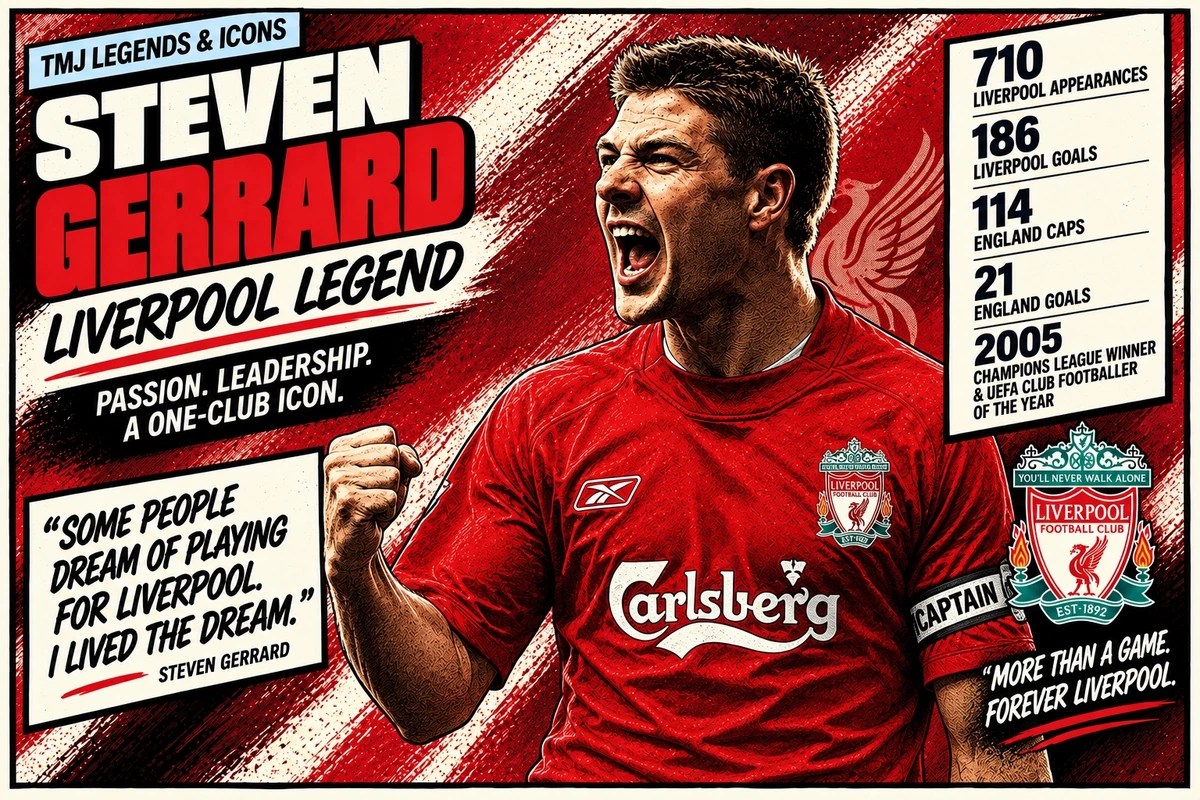
Steven Gerrard: The Liverpool and England Icon Who Defined An Era
Steven Gerrard: The Liverpool and England Icon Who Defined An Era: Before Steven Gerrard became Liverpool’s defining midfielder of the modern era, he was a local academy player from Whiston trying to force his way past established professionals. What followed was a 17-year Anfield career built on drive, range, leadership and an unusual habit of becoming central to the biggest moments. Steven Gerrard combined the responsibilities of a central midfielder with the emotional weight of captaining his boyhood club.
Steven Gerrard is a former England midfielder best known for his 17 first-team seasons with Liverpool. He captained the club from 2003 until his departure in 2015, won the Champions League, UEFA Cup, two FA Cups, three League Cups and a UEFA Super Cup, then finished his playing career with LA Galaxy.
His career was never defined by one fixed midfield role. Gerrard could protect the back four, dictate from deep, break lines with the ball, cross from wide areas or arrive near the box. Liverpool built different teams around him because his game could absorb different responsibilities without losing its competitive edge.
Steven Gerrard At A Glance
What Do Gerrard’s Liverpool Numbers Actually Say?
According to Liverpool FC’s official player profile, Gerrard finished his Anfield career with 710 appearances and 186 goals between 1998 and 2015. The Premier League Hall of Fame record separately lists 504 appearances, 120 goals and 92 assists in the competition. Those numbers matter because Gerrard’s reputation was not built only on isolated cup moments; it was sustained across hundreds of league and European matches.
Liverpool’s 2026 “Liverpool’s Greatest” project ranked him No.1 after combining fan selections, statistics and former-player input. That is a club-led recognition rather than an objective universal ranking, but it captures how central he remains to Liverpool’s modern identity.
Whiston, The Academy And The First-Team Dream
Steven George Gerrard was born in Whiston, Merseyside, on 30 May 1980. Liverpool’s official profile records that he was spotted playing for Whiston Juniors at the age of nine, entered the club’s academy pathway and signed his first professional contract eight years later.
The route was not perfectly smooth. Back and groin problems interrupted his development, and the Liverpool midfield already contained experienced professionals. That context matters because the Gerrard story can look inevitable in hindsight. It was not. He had to become physically robust enough for senior football while proving that his aggression could be channelled into decision-making rather than simply intensity.
His first-team debut came on 29 November 1998 as a substitute against Blackburn Rovers. The early version was raw, mobile and fearless. Within two years he had become a regular for Liverpool and had earned his first senior England cap.
Breakthrough, The 2001 Cup Treble And A Bigger Role
The 2000-01 season established Gerrard as more than a promising academy graduate. Liverpool won the League Cup, FA Cup and UEFA Cup under Gérard Houllier, and Gerrard’s mix of athleticism and technical range became increasingly important to a side built around structure, counter-attacking and strong personalities.
He scored in the 5-4 UEFA Cup final victory over Alavés, a match that showcased the qualities that would become familiar throughout his career: arriving from midfield, striking cleanly, pressing aggressively and influencing games beyond one narrow position.
Two years later he scored in the 2003 League Cup final victory over Manchester United. By then, Liverpool were no longer asking whether Gerrard could belong at the highest level. The question was how much responsibility could be placed on him.
Becoming Liverpool Captain
Gerrard became Liverpool captain in 2003. It was more than an armband change. The role placed a local academy graduate at the centre of the club’s public identity during a period of transition, and it amplified the expectation that he should influence matches tactically, technically and emotionally.
His game was suited to responsibility because it was visible. A 40-yard switch of play, a recovery tackle, a forward surge or a late shot could alter a match immediately. But his importance was not simply theatrical. Gerrard also carried possession through pressure, covered ground in transition and gave managers the freedom to change his role depending on the opposition.
The arrival of Rafael Benítez in 2004 sharpened that flexibility. Liverpool became more tactically structured, and Gerrard was used in multiple midfield positions. The following spring turned captaincy into legend.
Istanbul 2005 And The Night That Defined A Captain
Liverpool reached the 2005 Champions League final after a campaign filled with narrow margins. In Istanbul, AC Milan led 3-0 at half-time. Gerrard’s header in the 54th minute began Liverpool’s comeback, followed by goals from Vladimír Šmicer and Xabi Alonso. The match finished 3-3 before Liverpool won the penalty shootout.
The comeback is remembered collectively, and rightly so. Jerzy Dudek’s saves, Šmicer’s strike, Alonso’s equaliser and the wider team’s response all mattered. Gerrard’s role was still distinctive because the captain supplied the first goal at the moment Liverpool needed proof that the contest was still alive.
UEFA later named Gerrard its 2005 Club Footballer of the Year, recognising the season in which he led Liverpool to the European Cup. That award gives useful context to Istanbul: the final was not an isolated burst of drama but the peak of a campaign in which he repeatedly shaped Liverpool’s European survival.
How Steven Gerrard Played
Gerrard is often described as a complete midfielder because his influence covered so many phases. The phrase can become vague, so the more useful question is how those qualities actually appeared on the pitch.
Passing Range
Could switch play quickly, hit early diagonals, cross from the right and play direct passes that turned defence into attack before opponents had reset.
Power & Shooting
Attacked open grass with long strides and threatened from distance, forcing defenders to step out earlier than they wanted.
Two-Way Influence
Pressed, tackled, recovered and then joined attacks. His best performances linked defensive urgency to immediate forward action.
Premier League records give the attacking side of that profile useful scale: 120 goals and 92 assists in 504 appearances. Yet numbers alone miss the tactical flexibility. Gerrard could be a deep midfielder, a box-to-box runner, a right-sided midfielder or an advanced partner behind a striker depending on what Liverpool needed.
The Gerrard Final And FA Cup Glory
The 2006 FA Cup final against West Ham United became another shorthand for Gerrard’s ability to change a match. Liverpool trailed 2-0, recovered, then fell 3-2 behind. With the game deep into its final moments, Gerrard struck from around 35 yards to make it 3-3.
Liverpool eventually won the penalty shootout. The match became widely known as “The Gerrard Final” because he had also scored Liverpool’s second goal and supplied the long pass for Djibril Cissé’s first. It is one of the clearest examples of his full-range influence compressed into a single game.
The point is not that Gerrard won matches alone. Football does not work that way. The value of the final is that it shows why teammates and supporters trusted him in unstable moments: he could solve different problems without waiting for the match to become tidy.
Six Major Tournaments And The England Years
Gerrard made his senior England debut against Ukraine in May 2000 and appeared at Euro 2000. He then missed the 2002 World Cup through injury, an important correction to the common assumption that his international career included that tournament.
He returned for Euro 2004 and later played at three World Cups: 2006, 2010 and 2014. He also appeared at Euro 2012, meaning his England career included six major tournaments in total. The FA records 114 caps, 21 goals and 38 appearances as captain.
Gerrard became permanent England captain under Roy Hodgson in 2012 and led the side at Euro 2012 and the 2014 World Cup. His international career ended after Brazil 2014, closing a 14-year span with the senior side.
As of September 2026, England Football lists Gerrard fifth on the men’s all-time appearance table, behind Peter Shilton, Harry Kane, Wayne Rooney and David Beckham. That ranking has changed over time as more players have moved past the century mark, which is why current context matters when presenting historical records.
Steven Gerrard Career Record And Major Honours
The record below separates Liverpool totals, Premier League numbers, England figures and major team honours so different competitions are not blurred together.
| Record / Honour | Detail |
|---|---|
| Liverpool | 710 competitive appearances · 186 goals · 1998-2015 |
| Premier League | 504 appearances · 120 goals · 92 assists |
| England | 114 caps · 21 goals · 38 captaincies |
| England major tournaments | Euro 2000, Euro 2004, 2006 World Cup, 2010 World Cup, Euro 2012, 2014 World Cup |
| UEFA Champions League | Winner 2004-05 |
| FA Cup | Winner 2000-01, 2005-06 |
| League Cup | Winner 2000-01, 2002-03, 2011-12 |
| UEFA Cup | Winner 2000-01 |
| UEFA Super Cup | Winner 2001 |
| Premier League Hall of Fame | Inducted 2021 |
| Liverpool’s Greatest | Ranked No.1 in Liverpool FC’s 2026 club project |
Why Steven Gerrard Still Matters
Gerrard still matters because he became a reference point for the idea of the all-action English midfielder. Modern tactical language is more specialised, but the qualities remain recognisable: break pressure, cover ground, play forward, create, score and lead.
He did not win the Premier League as a player, an absence that is part of the record rather than something to hide. Liverpool finished second in 2001-02, 2008-09 and 2013-14, and Gerrard’s legacy rests more heavily on longevity, cup success, European nights and individual influence than on a domestic league medal.
The Premier League inducted him into its Hall of Fame in 2021. Liverpool’s own 2026 project then placed him first among the club’s greatest players. Different exercises measure greatness differently, but both recognitions underline the same point: Gerrard’s career remains inseparable from how Liverpool and the Premier League remember the first decade and a half of the 21st century.
The Midfielder Who Made Responsibility Visible
Steven Gerrard was more than a midfielder with a dramatic highlight reel. His career worked because the spectacular moments were supported by years of repeatable value: passing range, defensive effort, transition running, set-piece quality and the willingness to accept difficult jobs.
Istanbul and Cardiff became symbols because they compressed that responsibility into unforgettable moments. The broader legacy is quieter but larger: for 17 Liverpool seasons, Gerrard made one of the game’s most demanding midfield roles feel personal.
Steven Gerrard Questions
Who is Steven Gerrard?
Steven Gerrard is a former England midfielder who spent 17 first-team seasons with Liverpool before finishing his playing career with LA Galaxy.
How many appearances did Steven Gerrard make for Liverpool?
Liverpool’s official record lists Gerrard with 710 competitive appearances and 186 goals between 1998 and 2015.
How many Premier League goals did Steven Gerrard score?
The Premier League records Gerrard with 120 goals and 92 assists in 504 appearances.
How many England caps did Steven Gerrard win?
Gerrard won 114 senior England caps, scored 21 goals and captained the national team 38 times.
Did Steven Gerrard play at the 2002 World Cup?
No. Gerrard missed the 2002 World Cup through injury. His three World Cup appearances came in 2006, 2010 and 2014.
Did Steven Gerrard win the Premier League?
No. Gerrard did not win the Premier League as a player, although Liverpool mounted several title challenges during his Anfield career.
Why is Steven Gerrard considered a Liverpool legend?
He captained Liverpool for more than a decade, won the 2005 Champions League, made 710 appearances and was ranked No.1 in Liverpool FC’s 2026 “Liverpool’s Greatest” project.
Sources & Verification
Core claims were cross-checked against Liverpool FC, the Premier League, UEFA, England Football and The FA. Current England all-time appearance context was checked against England Football’s September 2026 list.
- Liverpool FC: Steven Gerrard player profile
- Liverpool FC: Liverpool’s Greatest No.1 — Steven Gerrard
- Premier League Hall of Fame: Steven Gerrard
- Premier League: Gerrard’s Hall of Fame career numbers
- UEFA: Club Footballer of the Year winners
- The FA: Gerrard retirement and England record
- England Football: Steven Gerrard profile
- England Football: all-time men’s caps list
- Liverpool FC: 2006 FA Cup final